On Monday we looked at some common mistakes with bullet points and how to fix them. Let’s see if we can use those tips to tidy up this piece of writing:
Bullet points can make a piece of writing easier to read. However, in this case, the writer has used them as a catch-all for various different points, rather than for one specific list. Every sentence is a bullet point, so the bullet points have much less impact.
To make the most of bullet points, the writer needs to identify a specific list within the text. Let’s pick out the points in the category ‘advice for customers’?
By using the bullet points for one specific section, we’ve given this piece of writing a better structure. The four bullet points are now much quicker to read. They also break the rest of the text up into clearer parts. We haven’t lost any of the meaning or demoted any of the information. We’ve just made each sentence more effective. It’s a win-win!
Have these tips about bullet points helped you give structure to your writing? Let us know in the comments below…
Last week we were thinking about bullet points and why they can make life easier for both you and your reader. This week, we’re looking at how to use bullet points practically when you need to write a list.
There are a few common mistakes with bullet points, but it’s easy to fix them. Here are a couple of tips to help you get bullet points right:
1.) Your bullet points should ‘match’
Because bullet points are such a handy tool, it can be tempting to use them as a kind of ‘catch all’ for any miscellaneous points you need to make in your writing.
For example:
At Wafflington Crown Hotel, we provide all overnight guests with:
towels
soap and toiletries
free Wifi
television
breakfast is served from 7am until 10am
please return your key to reception at the end of your stay
The first four points on this list are all in the same category (‘things that the hotel provides’). They can all be used to complete the sentence at the top.
However, the last two points on this list don’t really fit into this category. They may be relevant, but they don’t need to be in this list.
You can tackle this common mistake by thinking about your list of bullet points like a shopping list.
It’s the kind of list we all know how to write without thinking and it’s a great example of how bullet points work.
Shopping list
milk
eggs
bread
washing powder
Sellotape
All the points on this list match. They all fit into the category of ‘things I need to buy at the shops’. You wouldn’t put ‘make birthday cake’ on a shopping list. It’s a separate point, so it doesn’t fit on the list.
2) Bullet points should make sense.
Another top tip is to make sure your bullet points make sense when they’re read.
It’s common to see lists like this:
Welcome to the Wafflington Summer Fayre! There are lots of fun things to do and see including:
bouncy castle
there will be face-painting from 2pm onwards
a magic show
balloon modelling, dog competition, flower show
we also have a number of live musical acts performing
All these points do fit into the category of ‘things happening at the fayre’, but there’s something a bit strange about the way they’ve been written.
Each point should complete the sentence at the top of the list.
Some of them do this:
There are lots of fun things to do and see including a magic show
But some of them don’t:
There are lots of fun things to do and see including there will be face-painting from 2pm onwards.
It’s a common problem but it’s quick to fix. We can easily tidy up this list so that it makes more sense for the reader:
Welcome to the Wafflington Summer Fayre! There are lots of fun things to do and see including:
a bouncy castle
face-painting (from 2pm onwards)
a magic show
balloon modelling
a dog competition
a flower show
a number of live musical acts
Do you see how each point matches and follows on naturally to complete the sentence at the top of the list? It’s the work of only a few seconds, but it makes such a big difference.
Now that you’ve got bullet points under your belt, you’re ready for the Write for Real People Workshop on Thursday, where we’ll be putting this tip to the test…
Bullet points can make life easier for both you and your reader. Let’s see how they can transform this job advert:
This is a classic example of someone who doesn’t realise they are writing a list.
The writer has buried the list of qualities needed for the role in a lot of unnecessary waffle. This makes it harder for the reader to work out what the company is looking for.
Let’s pick out the list of key skills that the candidate needs to have:
The writer has made their own life difficult by finding five different ways to say ‘The candidate should have this skill’. They’ve also put the instructions about how to apply in the middle.
Bullet points can help to bring structure to this kind of writing and make it much clearer to read. Let’s see what difference they make:
The result is a job advert that is much quicker and easier to read. At a glance, the reader can scan the list, understand what the company is looking for and decide whether they want to apply.
Now that we’ve discussed why to use bullet points, we’re ready to think about how to use them. Come back next week for some practical tips on how to make bullet points work for you.
Have bullet points made a difference to your writing? Tell us why in the comments below.
When you’re writing for real people, bullet points can be your best friend.
You might have been told that it’s better to write everything out in full. Perhaps you’re worried about being unprofessional or too simplistic.
Whatever your concerns about bullet points are, here are two great reasons to make them part of your writing repertoire:
Bullet points make the reader’s life easier.
Here’s an example of some information without bullet points:
For the field trip, you will need to bring appropriate outdoor clothing. Please make sure you have walking boots as well. We also recommend you bring gloves. The coach will leave at 8am. Please arrive by 7.45am at the latest. In terms of equipment, everyone should have a notebook with them, and a camera or a mobile phone with a camera on it. There are no catering facilities at the site, so it is important that you bring a packed lunch with you. The coach will return at 4.30pm. You may wish to pack a change of clothes.
The key facts are buried in these sentences. The reader has to work hard to dig out the information they need, which is the timings and the items they need to bring.
The writer might have done this because he thought full sentences were more ‘proper’. There certainly are times when it’s best to write everything out in full, but if you’re writing any kind of list, bullet points are usually the way to go.
Alternatively, the writer may not have realised that he was writing a list at all. This is a common mistake. If you’re not clear about what you’re writing, it will be much harder for the reader to understand and follow your instructions.
Let’s pick out the key information and add some bullet points:
Please arrive for the field trip by 7.45am at the latest.The coach will leave at 8am and return at 4.30pm.
You will need to bring:
appropriate outdoor clothing
walking boots
gloves
a notebook
a camera (this can be on a mobile phone)
a change of clothes
a packed lunch (there are no catering facilities on site)
Do you see how bullet points have made this information much clearer for the reader? It’s a great way to quickly transform your writing and make your reader’s life easier.
2. Bullet points make your life easier.
Bullet points are also great for you, the writer. You might feel as though you should disguise a list in more interesting language, but there’s usually no need.
Here’s a writer who has tried to avoid using bullet points:
Singing together since 2014, Wafflington Chamber Choir have won numerous awards in recent years, including first place in the ‘Best performance – senior’ category at the Heart of Wafflington Festival, 2016. Based in North Bumbleshire, we were delighted to come joint third in the ‘Traditional musical ensemble’ competition at Bumbleshire County Performance Awards in 2015. Our choir master Beverley Warble continued to lead us to success in 2017. Previously awarded first place at the ‘Choir of the year’ awards by North Bumbleshire Chamber Music Association in May, we were lucky enough to win ‘Best Christmas choral ensemble’ at Bumbleshire Amateur Musician Awards 2017.
This rather impressive list of awards is tiring to read, and must have been equally tiring to write. The writer has had to work hard to force all these accolades into full sentences. They’ve done their best to make it interesting, but it’s still rather repetitive and hard to follow.
Here’s a much easier option:
Wafflington Chamber Choir is an award-winning choir based in north Bumbleshire. We’ve been singing together since 2014 and our choir master is Beverley Warble.
‘Choir of the year’ (first place), North Bumbleshire Chamber Music Association 2017
‘Best performance – senior’ category, Heart of Wafflington Festival 2016
‘Traditional musical ensemble’ (joint third), Bumbleshire County Performance Awards 2015
Much better. Instead of forcing this list into lengthy, complicated sentences, we’ve taken the easy route and used our trusty bullet points to make it clear and simple. It’s easier to read and easier to write.
Ready for more bullet point action? Come back on Thursday for our next session in the Write for Real People Workshop.
Welcome back to the Write for Real People workshop.
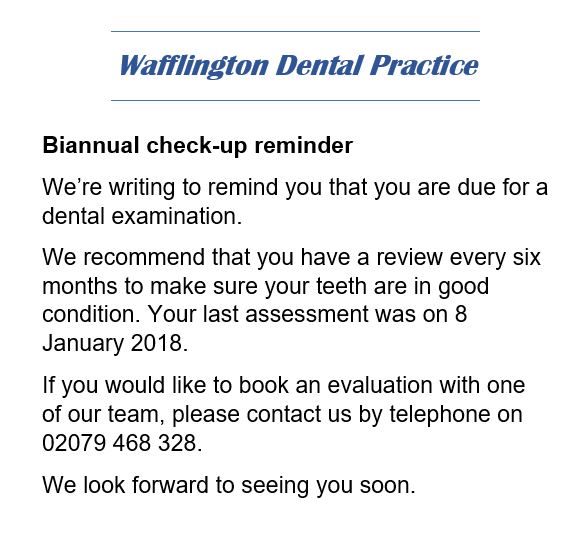
Today we’ll be trying out the ‘Repetition, repetition, repetition’ tip on this letter from Wafflington Dental Practice:
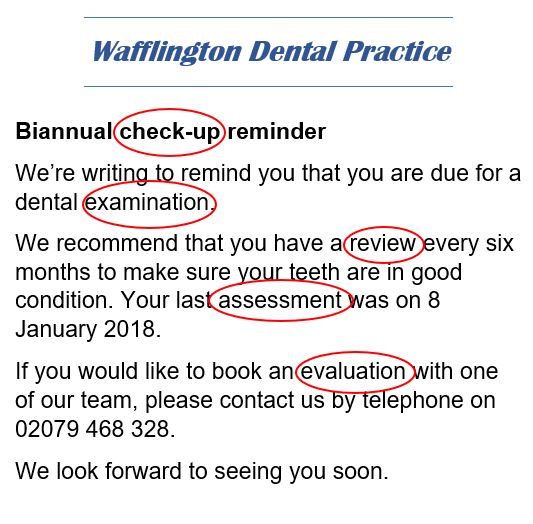
It’s a straight-forward message, but the writer has made it much more confusing by using five different words for ‘check-up’ :
The writer has also used both ‘biannual’ and ‘six month’. Top marks for an impressive vocabulary!
However, all these different words actually make it harder to understand the simple meaning of the letter. It would be better to choose one word and repeat it.
The ‘Repetition, repetition, repetition’ tip is easy but effective. Give it a try next time you’re writing for real people.
Got any repetition tips? Let us know in the comments below.









 Sarah de Mars